
I Had a 1,095-Day Duolingo Streak. The Day It Broke, People Asked If I Was Okay.
I was "the Duolingo guy"
For three years, I opened Duolingo every single day. 1,095 days. Through flights, through illness, through time zones. I was the person in my friend group who everyone associated with that green owl. My streak was a running joke at dinners, a conversation starter at parties, a point of genuine pride.
The day I finally broke it, my phone lit up. Friends texted. Colleagues messaged on Slack. Someone literally asked if I was okay, like something bad must have happened for me to let the streak die.
That reaction told me everything about what Duolingo actually is. Nobody asked "did you stop learning Japanese?" Nobody said "what about your Cantonese?" They asked about the streak. Because the streak was the product. Not the language. The streak.
I speak 11 languages. I've spent over 15 years learning them. I know what progress feels like: the first time you catch a joke in a foreign film, the moment a taxi driver stops switching to English, the day your partner's grandmother stops laughing at your pronunciation. None of that happened because of Duolingo. It happened despite it.
What 1,095 days of Duolingo actually taught me
Here's what my Duolingo profile looks like. Fifteen languages. Over 160,000 XP combined. German alone at 30,000. Arabic at 27,000. I didn't dabble. I committed.
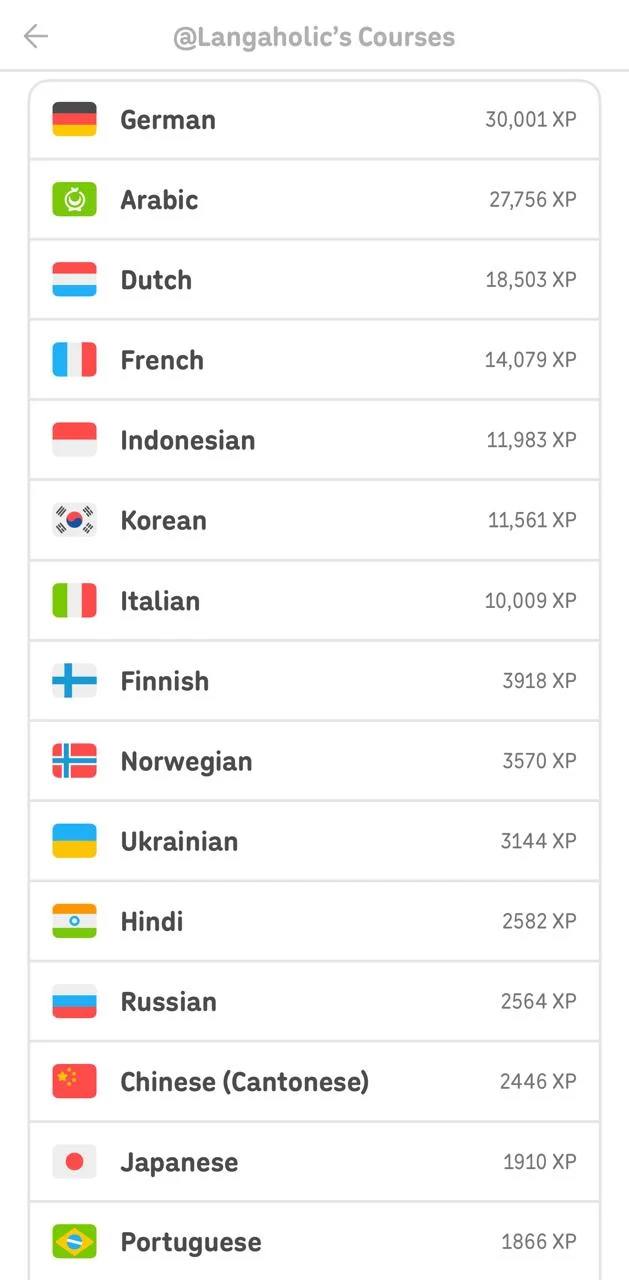
After three years of daily use across all of those languages, here's what I could do: match pictures to words, arrange tiles into sentences, and translate phrases like "the elephant is important" with near-perfect accuracy. Here's what I couldn't do: have a five-minute conversation with a real person.
That's not an exaggeration. I maintained courses in Mandarin and Japanese on Duolingo while living in Tokyo. My coworkers spoke both languages around me every day. The gap between what Duolingo was teaching me and what I needed to function in real life was so wide that I stopped trusting the app somewhere around day 600. But I kept opening it. Every day. For another 495 days.
Why? Because by that point, the streak was the only thing left. I wasn't learning. I was maintaining a number. And the app was designed to make that number feel more important than actual progress.
That's the gamification trap. You optimize for the metric (streak, XP, league position) instead of the outcome (speaking the language). And because the metric keeps going up, you feel like you're succeeding. You're not. You're just loyal.
Wall Street finally did the math
Duolingo's Q4 2025 earnings confirmed what serious language learners already knew. Monthly active users dropped sequentially from 135.3 million to 133.1 million. The leaky bucket got bigger.
To fight that churn, Duolingo is spending significantly more on marketing, which means customer acquisition costs are climbing. The CEO acknowledged they over-monetized the platform with aggressive ad walls, restrictive energy mechanics, and paywalled progress. Now they're trying to walk that back, sacrificing short-term revenue to fix a user experience they broke themselves.
The most telling signal? A $400 million share buyback. For a company that's supposed to be in hyper-growth mode, returning cash to shareholders instead of investing it in the product means management doesn't have a better idea for how to spend it. They have $1 billion in cash and can't figure out where to put it. That's not confidence. That's a company running out of moves.
The stock went from $545 to around $100 in under a year. An 80% crash. Analysts blame AI competition and shifting strategy. But the real diagnosis is simpler: the product was never the product. The marketing was the product. And when marketing can't outrun the reality that users aren't actually learning, the stock price tells the truth.
Google validates the thesis (but doesn't solve the problem)
While Duolingo was losing users, Google quietly built something interesting. Little Language Lessons (originally "Tiny Lesson") was a Google experiment that generated personalized vocabulary and phrases based on real situations. You tell it you're taking a taxi in Lisbon, it gives you the Portuguese you'd actually need.
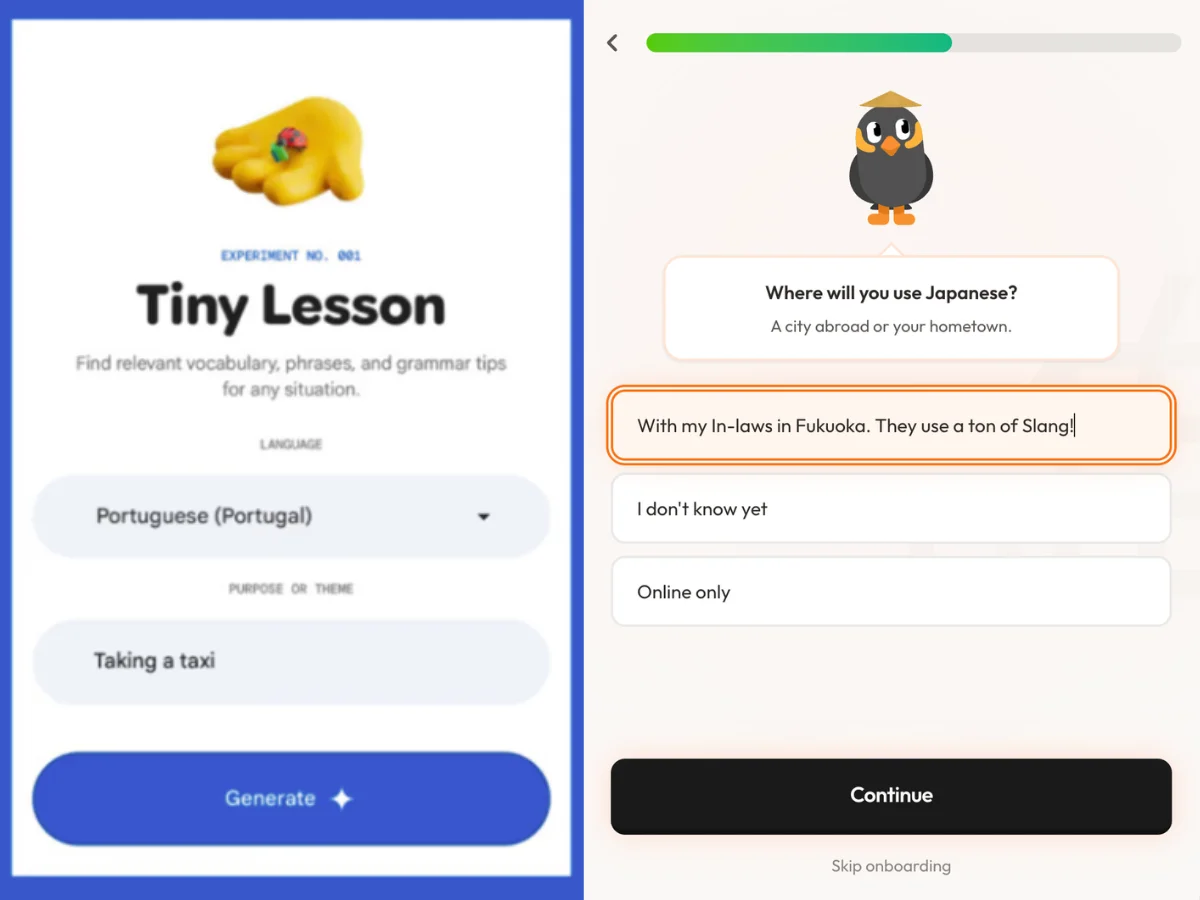
Sound familiar? That's exactly what I built with Mynago. Independently. In Tokyo. Because after 15 years and 11 languages, it was obvious that this is how language learning should work: context first, your life as the curriculum.
When a $2 trillion company arrives at the same conclusion you did, that's not a threat. That's validation.
But here's what Google got wrong: Little Language Lessons has no methodology. It's an engineer's demo, not a learning system. There's no spaced repetition. No progressive difficulty. No curriculum that remembers what you've learned. No grammar instruction. No cultural context. It generates a nice list of phrases, and that's where it ends.
It's the equivalent of giving someone a phrasebook and calling it a language course. Useful for a tourist who needs five sentences for a taxi ride. Useless for someone who wants to actually learn a language.
Google built the input layer. They skipped everything else. No memory system means you forget 80% of what you saw within a week. No progression means you can't build on previous knowledge. No exercises means you never practice producing the language, just reading it. It's a prototype that validates the concept of contextual learning while proving that the concept alone isn't enough.
I built a full learning system with FSRS spaced repetition, progressive difficulty, exercises, pronunciation practice, cultural notes, and a curriculum that tracks everything you've ever studied. Google built a demo. A year later, it's still a demo.
What actually works (and what I built instead)
After I broke my streak, I didn't stop learning languages. I stopped pretending that gamification was learning.
The methods that actually produce fluent speakers haven't changed. Comprehensible input. Spaced repetition. Contextual learning. Cultural immersion. These are the principles behind Pimsleur, Assimil, the FSI courses, and every polyglot's actual practice routine. They work. They've always worked.
What they lacked was personalization. Pimsleur teaches the same dialogue to everyone. Assimil uses the same situations for every learner. The FSI courses were built for diplomats headed to specific countries.
That's the gap I built Mynago to fill. Not gamification. Not a demo. A complete learning system where every lesson is about your actual life. Your partner's family dinner. Your business trip. Your move abroad. With the spaced repetition engine that actually makes things stick, the cultural context that tells you why things are said a certain way, and the exercises that force you to produce the language instead of just recognizing it.
No streaks. No XP. No leaderboards. The reward for learning a language is speaking the language. That should be enough.
The bottom line
Duolingo's gamification trap isn't just a product failure. It's an industry-wide lesson. Engagement metrics are not learning outcomes. A user who opens your app 1,095 days in a row but can't order coffee is not a success story. They're a cautionary tale. I know because I was that user.
Google's Little Language Lessons proves that the smartest minds in tech agree: language learning needs to be contextual, personal, and situational. But a demo without methodology is just a phrasebook with better UI.
The future of language learning isn't gamification (Duolingo) or AI demos (Google). It's systems that combine what polyglots have always known works with the personalization that technology finally makes possible.
If you've been protecting a Duolingo streak and wondering why you still can't have a conversation, that's not your failure. That's the app working exactly as designed. It was designed to keep you coming back. Not to make you fluent.
I know because I came back 1,095 times. Then I built the thing I actually needed.
If you're thinking about switching, you don't have to start from zero. Mynago lets you import your Duolingo streak in Settings, so the days you put in still count.
Start learning with Mynago. Your first lesson is about your life, not an elephant.